
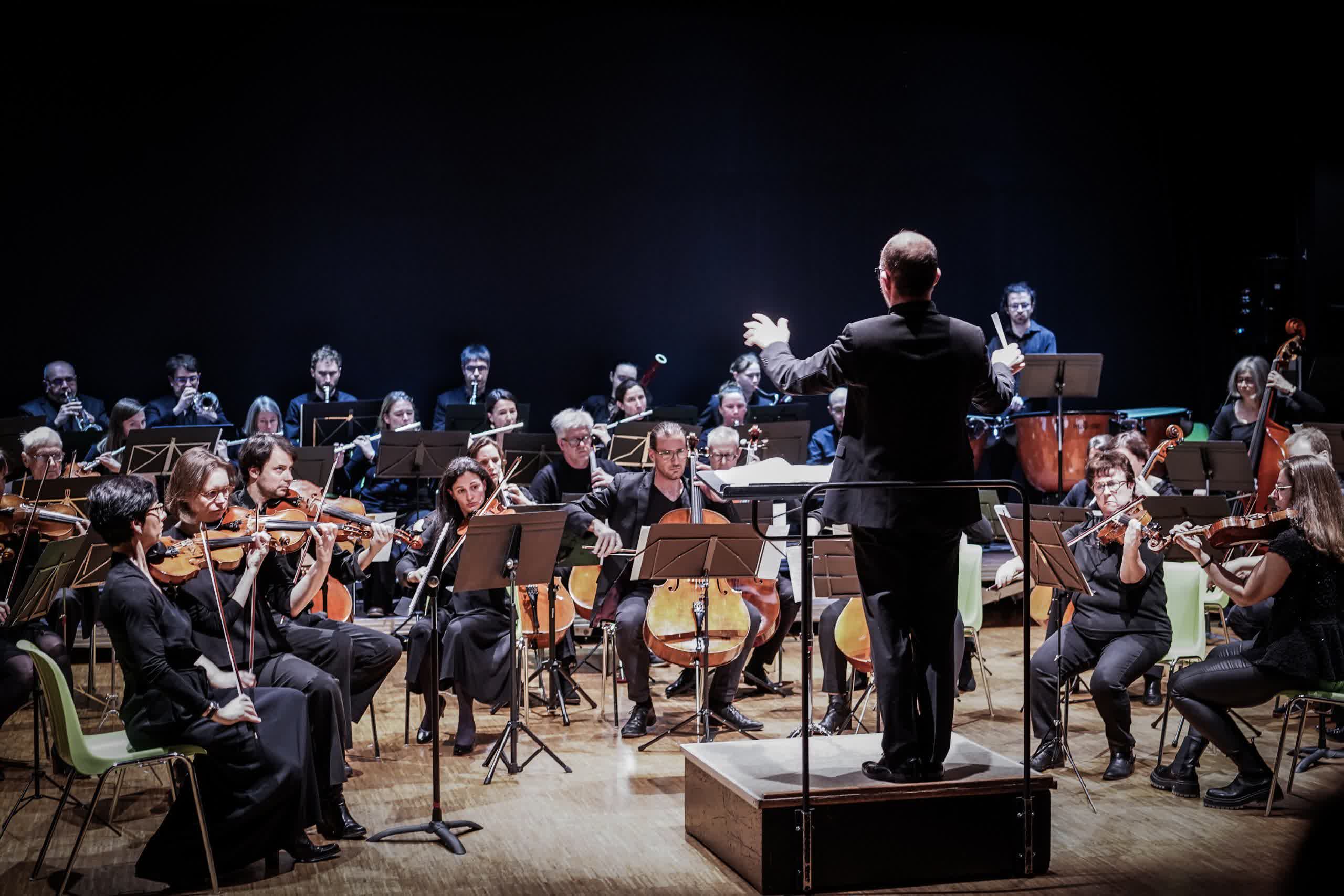
The orchestra, in brief
L'Orchestrale is an amateur orchestra in Nantes, France, founded more than a century ago. Sixty-seven musicians, four to six concerts a season, a mainly Romantic repertoire that sometimes reaches into the early twentieth century or French music, with a few forays into film music or more varied styles. Its finances have tightened over the years: municipal subsidies have gradually shrunk, and the budget now rests mainly on members' dues and concert revenue.
Like most association-run orchestras, its board long handled the day-to-day machinery with whatever tools were at hand: a Google Drive for the scores, email chains for announcements, WhatsApp groups by section. For the past ten months, L'Orchestrale has been using Sostenutoo. The switch happened gradually, feature after feature, at a pace set by the board.
Before: a system that worked,
but weighed on everyone
At L'Orchestrale, every new programme set off the same sequence of tasks that the board took on itself, season after season.
When the conductor announced the programme, someone on the board downloaded the scores, uploaded them to the association's drive, then sent each section the link matching its instrument. In an even earlier era, the files went straight out by email: about fifteen separate sends per programme.
The arrival of a new musician was a challenge in itself. You had to track down their email address — sometimes through a third party to get it — then identify the right links on the drive for their instrument. Jean-Charles remembers running a genuine investigation to find the correct address of a double bass player, before he could even send her the scores.
Bowings followed the same circuit. Each change meant an updated PDF, an email to everyone, fragmented replies. Attendance was sorted out verbally at rehearsal or by exchanging emails: “who's away for the next concert?”
Nobody disputed that the system worked. But nobody would have said it was resting easy either.
A gradual adoption,
feature by feature
The switch happened gradually, feature by feature.
Sheet music, from the very first month
The secretary took hold of the tool and uploaded the entire library. Because sorting by instrument is automatic, every musician immediately received access to their parts. No more emails to assemble one by one, no more hunting for addresses for newcomers.
Bowings, from section to section
Sophie tried it out on her violins. The time saved was immediate, and the principal cellist adopted the same method. Today, a change is shared with the whole section without a single email going out.
Absence declarations
Gradually, musicians got into the habit of reporting their absences from the app. Today, the board can give the conductor, right at the start of rehearsal, the precise list of under-strength sections. Previously, this information was discovered mid-session.
It takes me three seconds, just the time to click.
What changed,
concretely
For sheet music, the emails are gone. Every musician finds their files sorted by instrument as soon as they log in. For bowings, the change is of a different kind: there is no longer a score to retouch, no PDF to recreate, no file to re-upload.
Sharing bowings is probably the feature that has changed section leaders' daily lives the most. Before, changing a bowing meant annotating the score, regenerating the PDF and re-uploading it. Now you add a bowing directly in the app — and it is immediately visible to the whole section. The principal cellist did the same for her section. What used to require a whole sequence of operations now takes a few seconds.
Beyond bowings, several tasks have changed in nature. The list of musicians is permanently up to date because each person manages their own profile. Departures and arrivals are reflected automatically. New musicians access their scores as soon as their registration is approved. The attendance expected at a rehearsal or a concert can be seen at a glance.
The board can also count on responsive support. The principal cellist reported a problem saving her bowings: she told Sophie, who passed the request straight to support. The problem was solved within a few hours. The next morning, she could enter her bowings normally.
The most unexpected effect:
new musicians
This is probably the deepest transformation, and the least anticipated.
Before, integrating a new musician meant scattered work: getting their address, adding them to the mailing list, sending them the history of programmes, checking they had indeed received their section's scores. Today, the mechanism is reversed. The new musician signs up on the platform themselves, and the organisation immediately appears to them as a given.
For them, it's a given. It would be a lapse not to use it. It's not at all the same mindset.
This psychological reversal is worth more, in the long run, than all the minutes added together. The orchestra has used the platform for ten months and has taken out an annual subscription.
What you take away
with Sostenutoo
Jean-Charles, vice-president, sums up in his own way what changed between before and after.
“It's as if twenty years ago you asked someone: do you use Word? And I've got paper, a pencil and an eraser. It's the difference between no system and a system.”